Helical stacks have actually earned their location in business work because they incorporate predictable actions along with prompt setup. You obtain prompt ability analyses coming from torque correlation, and you can mount in tight city web sites with low spoils. Still, every seasoned installer and designer recognizes the very same fact: the real proof of a deep-seated groundwork is in the bunch test. On a health center addition in clay-based, on a storage facility piece where negotiation tolerances are stingy, or on a keeping wall structure using helical tieback anchors, you only obtain self-confidence when the piles or supports present their performance under controlled load.
This article focuses on load screening protocols customized to commercial helical pile installation and helical tieback anchor work. It additionally touches the edges where micropiles, protection heaps, and also various other deep foundation repair techniques comply with the same need for verification. The goal is practical support: what to examine, exactly how to check it, and how to interpret the end results without obtaining misguided through sound in the records or even outlandish expectations.
Why our company evaluate, also when torque looks good
Helical piles possess an influential purchases sound: put up with a calibrated ride crown, display torque, as well as connect to ability. In tidy sands and also residues, the relationship usually holds within 10 to twenty percent, which is actually outstanding for production. Commercial helical pile installation, however, hardly ever occurs in book strata. Our experts find layered loads, varved clay-baseds, settled groundwater, as well as energy passages that have actually interrupted the ground over decades. Torque spikes are common, and also soft pockets can conceal in between tense horizons.
Load testing legitimizes 3 traits you may not see during the course of setup. First, the actual load move device at the helices as well as along the shaft. Second, creep behavior eventually, which matters when a commercial foundation stabilization program should reside under a sensitive superstructure. Third, the architectural functionality of the system on its own: couplers, stems, cement columns in combination systems, and also caps.
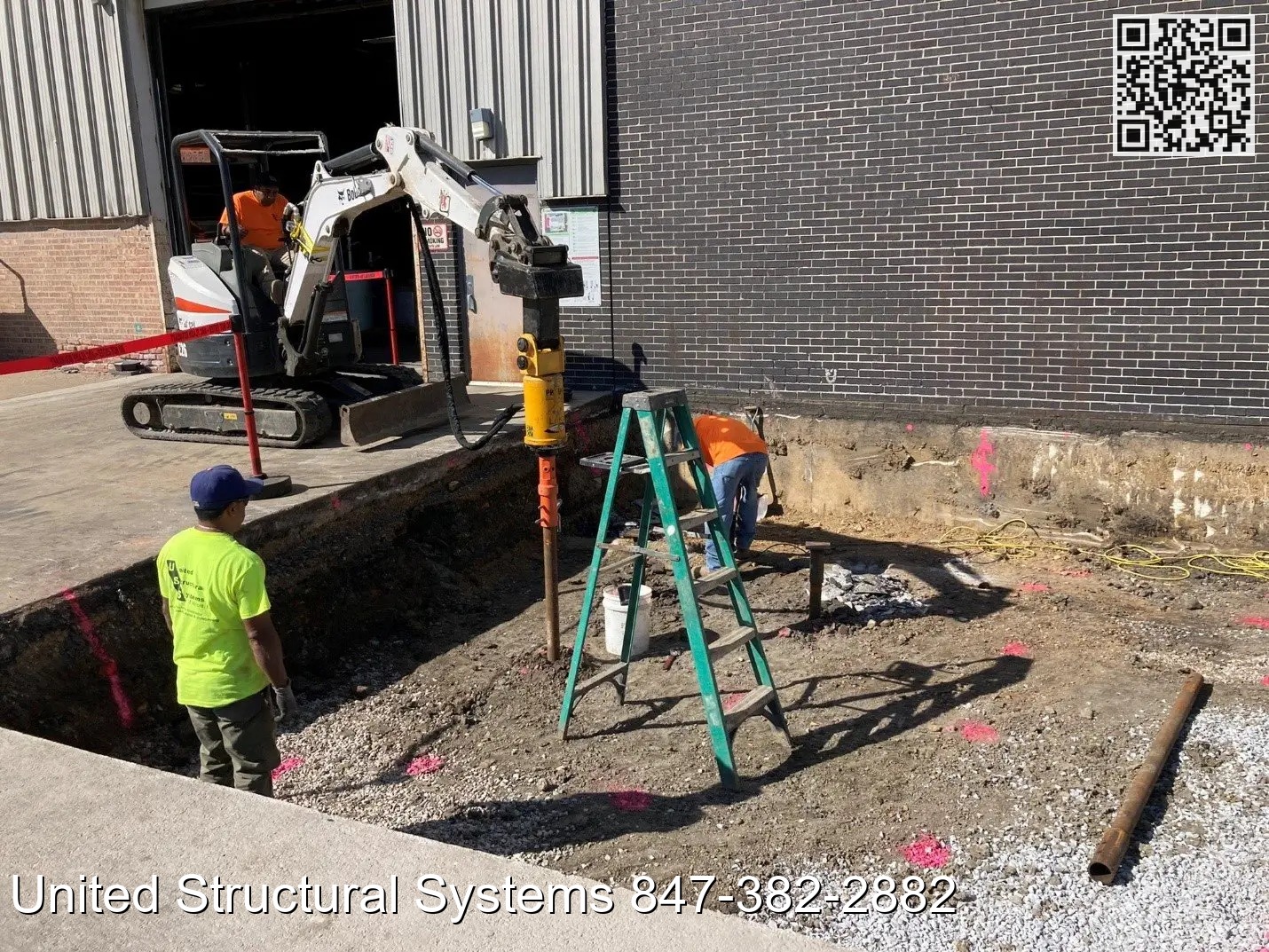
I remember a retail slab-on-grade retrofit where twist advised fifty kips per heap. The load examination showed acceptable supreme capability near that worth, but the action at solution load was extremely large for the piece. The repair involved making use of much larger top areas along with deeper helices to minimize curvature, not just chasing after much higher twist. Without a payload exam, our experts will possess met the letter of ability as well as still let down the owner along with slab curling as well as dividers cracking.
Choosing a test style that suits the project
Static axial squeezing as well as pressure examinations are the foundation for helical piles as well as helical anchors. Sidewise tests are less common however essential for signs, high rise bases, and also some cover assists. For tieback anchors, evidence as well as efficiency tests under pressure define the plan. Dynamic tests turn up much more along with steered piles than with helicals, as well as while you may function rapid load examinations on micropiles, helical units react most effectively to sustained fixed loading because displacement and creep under consistent lots are the crucial criteria.
For commercial resistance pile installation and also micropile installation, static tests follow similar logic, however the machinery contrasts. Micropiles usually invite pressure assesses to split up connect region from ground anchor region. Resistance piles, particularly push boat docks made use of in structural foundation repair, gain from on-jack evaluates that mirror service situations in the course of underpinning.
When owners request for market value engineering, the appeal is actually to cut tons testing first. That is actually an untrue economic condition. A singular effectively performed efficiency test on a sacrificial helical pile, plus proof tests on an amount of manufacturing devices, usually lessens the general danger as well as may even allow logical declines in product or even depth that spare greater than the examination costs.
Standards, criteria, as well as efficient thresholds
Most office standards draw from ICC-ES acceptance standards, ASTM criteria, as well as geotechnical suggestions. For helical piles and also helical anchors, the popular recommendations feature ICC-ES AC358 and ASTM D1143 for compression, ASTM D3689 for tension, and ASTM D3966 for lateral. Tieback anchors frequently follow PTI suggestions for testing and lock-off techniques. These papers lay out action running, hold times, as well as acceptance requirements for movement and creep.
Serviceability limits are as important as greatest capability. For commercial foundation repair and new building and construction, company bunch movement limits might vary coming from 0.25 to 0.5 ins at complete style bunch, sometimes tighter for slab-supported equipment. Creep criteria at the ultimate hold measure usually restrict movement to a handful of thousandths of an in every moment over a defined period, frequently 10 moments. The precise varieties get tuned to forecast demands, ground type, and also danger tolerance.
One functional guideline: if you are installing in smooth clay-baseds along with liquidity marks near 0.7 or even higher, demand longer hold time periods. Clay-based requires opportunity to present its shades. Sands answer quickly, but may show relaxation. Silts partake the uncertain middle. Your process should demonstrate the soil's time dependence or even you may pass an exam that eventually becomes a settlement claim.
Equipment that keeps records honest
Load screening gears are simply just as good as their recommendations. The response structure must be actually tight and also secured in such a way that carries out certainly not contaminate the size. For squeezing examinations on helical piles, this often suggests an exam shaft tied to surrounding response piles ingrained deep enough to stay clear of effect from the test pile. In strain, reaction structures get hold of onto anchors or even deadmen. For helical tieback anchor screening, the response is actually normally the wall itself or a steel strongback with adequate spreader beams.
Digital bunch tissues and also stroke transducers have ended up being the standard in commercial work, not simply nice-to-have. A 100-ton hollow ram coupled with a calibrated pressure transducer is actually great if you have a fresh gradation arc as well as validate every scale before the test series. Direct variation transducers positioned separately of the jack, reading against a taken care of endorsement outside the response region, deal with the false movement that arises from framework curvature or port seats. If your data accomplishment unit records tons and displacement at 1 Hz or faster, trending as well as creep analysis come to be straightforward.
For micropiles as well as resistance heaps, you might additionally add dial evaluates affixed to a remote endorsement shaft to cross-check the digital instruments. Redundancy concerns when a small reading can persuade approval. On a courthouse underpinning along with resistance heaps, our team located a bent jack port giving higher stress analyses. The dial gauges said to the genuine story. That small cross-check spared a stack cut-off as well as re-drive.
Establishing an exam matrix that makes confidence
On large web sites, grounds vary. Checking a solitary helical turn in the shallow fill at the north edge tells you little regarding the much deeper alluvium near the stream. The exam source needs to have to disperse around the website, line up with the geotechnical profile, and also embody each design version: stack lead arrangements, coil sizes, shaft sizes, and also embedment depths. When commercial helical pile installation sustains both column bunches as well as slab bunches, test both cases. For helical tieback anchor deal with a tipped retaining wall structure, exam the uppermost and reduced workbenches given that additional charge and ground thickness will definitely differ.
A popular pattern sets a couple of performance exams, usually to 200 per-cent of concept bunch, with verification screening on 5 to 10 per-cent of creation units to 133 percent. Jobs along with higher consequences or even combined grounds might press performance exams to 250 percent and verification to 150 per-cent. Tieback anchors normally get evidence evaluated to a lock-off strategy, at that point loaded symphonious to 120 to 133 percent, along with creep measured on top grip. If movement or even creep goes beyond approval limitations, check out and readjust the design prior to waging production.
On a logistics storehouse outside Des Moines, we operated 3 performance examinations on helical piles along with 10-12-14 in coils. The southerly exam hit heavy sand early, and the capacity surpassed the twist estimate by almost 30 per-cent. The northern area rested over a silty clay-based layer and matched twist relationship within 5 per-cent. The middle area looked normal but presented evident creep at 150 per-cent of concept. We firmed up solution motion standards certainly there as well as specified longer coils to connect with a lesser strain perspective, which later maintained piece joints limited under forklift traffic.
Step filling that discloses true behavior
Static load tests need to stabilize productivity along with analysis value. Stepping too promptly hides time-dependent motions as well as may misdiagnose the ability. An audio method for compression could load the helical pile to 25 per-cent, half, 75 percent, 100 percent, at that point 133 percent, along with 5 to 10 moment stores at each step and also longer holds at the top. After getting to the maximum exam tons, dump in steps, securing briefly to tape elastic recovery. If the requirements requires a failure exam, carry on packing in much smaller increases till the action increases without load boost, or even up until you get to the risk-free restrictions of the frame.
For pressure, the measures and contains are identical. Pay attention to preliminary seating or bedding-in movement as the connections as well as grout, if any, take up resistances. Helical tieback anchors usually comply with an evidence examination cycle: chair at a small lots, cycle up to the optimal examination tons along with defined holds, after that return to the lock-off load. Creep is gauged merely on top tons on a fresh request, not in the course of cycles, to stay clear of challenging plastic prepared along with time-dependent deformation.
The hold opportunity controversy appears on virtually every work. Some desire five little stores for rate, others promote 10 or maybe 60 mins in clays. My technique is actually to align with the soil. Sands and also gravels, 5 minute conducts at intermediary measures and 10 to 15 minutes at the optimum are actually often sufficient. In fat clay-baseds, double those times. If your displacement curve flattens, you may validate going on. If it maintains slipping at a measurable cost, perform certainly not disregard the trend.
Reading the contours without misleading yourself
A great lots examination record tells a story. The load versus movement story presents rigidity improvements as helices interact different coatings, and the dump pathway mean shaft flexibility versus ground set. In a tidy outcome, the 1st component of the arc is steep, after that it softens as activated protection creates, and ultimately it either plateaus towards breakdown or even stays stable within the solution variety. Creep plots distinct flexible movement coming from time-dependent soil response.
Look for subtle clues. If the displacement dives at reduced loads, look for seats or framework slippage. If creep at 133 percent of style decreases from 0.005 ins every moment to 0.001 ins every min over the hold, that is healthy and balanced unification. If it remains at or over 0.01 ins per minute, particularly in clay-based, you are approaching a serviceability restriction even if best capacity is actually certainly not gotten to. Tiebacks with too much rebound on discharge may have bedding slop near the bearing layer rather than issues in the ground. Tidy up the bearing areas as well as retest prior to changing the design.
Micropiles and also resistance stacks tell similar stories along with slightly various trademarks. Micropiles along with a long connect span show a steady hardness boost as additional of the grout-rock interface sets in motion. Resistance heaps driven for deep foundation repair show load-displacement arcs dominated by abrasion along the shaft and also sometimes exhibit snap-back on offload if the pile secures into a stiffer layer at deepness. With all scenarios, consider exactly how the bunch transmissions and whether the monitored movement suits the device you expect.
The link in between installation information and also examination outcomes
Installers often live by twist charts, and also completely main reason. Helical torque to capability connections, adjusted by the particular coil geometry as well as shaft kind, produce a simple price quote of utmost resistance. A mistake I observe is dealing with twist readings as gospel all over mixed accounts. If the lead segment beings in stiff sand but the upper coil trips in loose stuffing, you can easily reach aim at twist while leaving behind the upper bearing factor underdeveloped, which injures rigidity and also increases negotiation under company bunch. A weight exam will definitely subject this in the early aspect of the curve.
Track torque every reformation, crowd tension, as well as Learn here fee of seepage. A continuous torque rise along with even penetration lead to consistent soil. Spikes along with stalls suggest cobbles or even particles. When these trademarks connect with the exam location, you get situation for the motion behavior. On a commercial helical pile installation under a chiller pad, we found terrific torque at shallow depth. The tons examination sensed soft at service. The remedy was turning deeper to seating all-time low coil in to pure soil, which stiffened the response as well as reduced the service movement in half.
For commercial resistance pile installation, the analog is disk pressure as well as stroke every push. For micropiles, it is actually grout take and also tremie tension in the course of placement, plus connection size and also rock outlet specifications. If the load examination points out one thing as well as your installment data state yet another, examine just before you select a side.
Acceptance standards that perform certainly not box you in
Rigid requirements typically induce excessive pile replacements. Practical recognition for a helical turn in squeezing could consist of a maximum web action at concept load, say 0.5 ins, and also a creep price below a defined limit, including 0.01 inches in the last minute of a 10 min grip at 133 per-cent of style. Tieback anchors typically need lower than 0.04 inches of motion in between one and also 10 minutes on top test lots, adhered to through steady lock-off. These are actually examples, not global market values. Projects with vulnerable exteriors or high-precision equipment may require tighter numbers, while majority storage or shelfs may tolerate more.
Remember the field in between supreme ability and company performance. You can obtain higher best capability with tiny coils in dense sand, as yet still possess extra flexible movement than the construct prefers. Bigger helices or even deeper embedment increase contact location and lower variation at solution. If a test directly falls short a company movement standard yet shows low creep and high greatest security, a modest redesign often fixes it without breaking up the heap type.
Tension screening and also the distinctions of tieback anchors
Helical tieback anchors act in a different way than upright heaps. The tons pathway undergoes the support head, along bum rap, and also right into the coils settled in the passive zone. The free size, whether a soft expansion or even a sleeved segment, have to continue to be unbonded near the wall surface to enable lock-off without bunch reduction. During the course of commercial helical tieback anchor installation, regular installment angle, helix space, and also depth responsible for the theoretical failure airplane matter more than a lot of appreciate.
A noise tieback verification examination patterns the bunch to the maximum exam amount, keeps for creep evaluation, and after that decreases to the lock-off tons while gauging flexible healing. Excessive non-recoverable action points to soil yielding or even seats ahead. If the support creeps unacceptably on top lots, you might be actually also close to the failure airplane or sitting in an unstable level. Expand the anchor or readjust the angle of inclination to go after much better dirt. Perform certainly not rely upon higher torque alone to handle a geometry problem.
Keep an eye on wall structure communication. I enjoyed a service provider criticize a tieback for creep when the strongback deflected under load, forging anchor activity. Independent reference ray of lights and also careful setup stop this. Really good testing shields both the installer and also the owner.
When tons testing satisfies fixing work
Deep structure repair service in commercial settings rarely gives the luxurious of open space. You are functioning in cellars, under mechanical spaces, or next to active electricals. For structural foundation repair that utilizes resistance heaps or helical piles, exam process require to adapt to limited allowances. Portable response frameworks, shorter movement jacks, and also segmented reference beams keep analyses well-maintained. Foundation crack repair and piece stabilization typically tie into this course, given that load screening informs how boldy you may raise or how much bunch to move prior to the structure responds.
I have possessed results utilizing a fly examination on pair of or even 3 underpinning aspects just before dedicating to a building-wide lift. The examination informs you how the ground circulates lots, just how the masonry or concrete are going to respond, and also what boost increments the construct puts up with. It can additionally show whether blended soil layers under different gulfs require different heap types, as an example making use of helical piles in sandier areas and micropiles where patches stop helical advance.
Documentation that stands up later
Commercial tasks live as well as perish through their records. A well-maintained bunch examination package deal includes gradation certificates, setup logs, examination techniques, uncooked and also decreased records, plots, pictures of the setup, as well as industry keep in minds describing any sort of abnormalities. When a 3rd party special assessor signs off, include their file. If you differed the authentic plan, present the developer's commendation. These files shield your team if conflicts occur and also provide functions staff a guideline for future modifications.
Many proprietors now anticipate electronic deliverables that supply right into their possession monitoring units. Straightforward actions like calling documents through stack ID and also location, staying with one correlative body, as well as adding a short narrative for every exam decrease hassles when somebody takes another look at the project years later.
Lessons learned from the field
- Load examinations hardly receive a second opportunity. Make the effort to put individual referrals and confirm every scale before the very first bunch action. A well-maintained very first examination gains depend on as well as rates authorization for the rest. Torque is a manual, certainly not a judgment. Use it to guide installation, then rely on bunch screening to verify your beliefs. If the results conflict, find out why, not who is actually right. Helical heaps master velocity, but speed tempts shortcuts. Always keep keep times that match the soil. A 10 min pause is actually economical matched up to a floor that clears up an one-fourth in under occupancy. Cross-train your team. The installer that recognizes just how tons examination arcs need to look will certainly observe a trouble during setup and also repair it before the exam subjects it. Accept that certainly not every pile will definitely be actually best. Style a test source and approval structure that flags outliers without delaying the whole job.
Where other bodies intersect
Commercial micro pile installation, typically meant micropile installation, reveals much of this screening DNA. Because micropiles rely on grout-to-ground connection, their efficiency depends upon building and construction high quality where you can certainly not view it. Stationary load examinations verify both bond strong point as well as architectural capacity of bench or casing. Tieback anchors, whether helical anchors or even grouted anchors, ask for the exact same regimented testing considering that their work is typically regarding solution motion control over time.
Resistance piles possess their area in structural foundation repair, especially when headroom is actually tight and also dirts permit dynamic jacking to lots. Evidence screening in the course of installation, making use of the property as reaction, affirms the tons each boat dock are going to bring. Supplemental static examinations on picked piers, individual of the structure, help calibrate assumptions as well as prevent overpromising to the owner.
When a task blends systems, like making use of helical piles for new columns as well as micropiles for highly jam-packed primaries, keep the screening protocols distinctive but worked with. The proprietor really wants one tale regarding performance, certainly not dueling charts.
Final ideas from a busy job trailer
When you manage commercial helical pile installation at scale, bunch screening ends up being much more than a checkbox. It is your reviews loop. It informs you whether a 12 inch top coil ought to be actually a 14, whether the embedment requires another five feet, whether the response frame is too gentle, and also whether your crew reads the ground efficiently. It separates a smooth handover coming from a nagging negotiation problem 6 months later.
The absolute best courses loop three strings. The geotechnical document collections desires for soil behavior. The installment logs catch genuine ailments. The load exams fix up both and write the functionality chapter. Carry out that, and the rest of the job complies with: commercial foundation stabilization proceeds with confidence, structural foundation repair stores its own line, as well as also the obscure foundation crack repair advantages since the foundation stays steady.
I have actually performed sites where a solitary truthful tons exam modified the velocity of the work for the better. We added deepness, changed a coil sequence, tightened a requirements, as well as everybody slept far better. That is the sign of a good protocol. It does certainly not simply pass or stop working a heap. It teaches you just how the ground is actually heading to handle your framework for the next fifty years.